


Patient Care in Emergency Medical Services
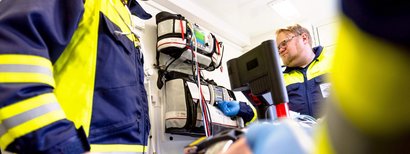
Providing professional patient care in emergency medical services presents emergency responders with the most demanding challenges on a daily basis: time pressure, challenging working conditions, and life-threatening situations require equipment that works reliably and is intuitive to use.
Patient care in emergency medical services: the essentials at a glance
- Patient care in emergency medical services encompasses all measures taken during the prehospital phase – from arrival at the scene to handover to the hospital.
- Mechanical ventilation is clearly superior to manual bag-valve-mask ventilation and reduces the workload on the emergency response team.
- Whenever possible, non-invasive ventilation (NIV) should be the preferred option for patients who are breathing spontaneously.
- Continuous patient monitoring is the foundation of all treatment management in the field.
Definition: what is patient care?
Patient care refers to the full range of diagnostic, therapeutic, and nursing measures that emergency responders take to stabilize patients’ conditions and ensure the best possible treatment.
In emergency medical services, patient care specifically refers to the prehospital phase – that is, the period from arrival at the scene until the patient is transferred to the facility providing further treatment.
This phase of patient care is divided into several key areas:
- Suction & airway management
- Ventilation & oxygen supply
- Defibrillation & resuscitation
- Monitoring & diagnostics
- Data management & handover
Key elements of emergency care in emergency medical services
Ventilation in emergency medical services and oxygen supply
Ventilation is one of the most critical procedures in prehospital emergency care. Lack of or insufficient ventilation leads to irreversible brain damage within minutes. The demands placed on the device and its users are correspondingly high.
Compared to manual bag-valve-mask ventilation, mechanical ventilation offers clear advantages:
- It ensures consistent, precise ventilation.
- It takes some of the pressure off the response team.
- It creates capacity for additional life-sustaining measures.
Studies show that in only 3 out of 106 cases of bag-valve-mask ventilation during CPR were all guideline-relevant ventilation parameters adhered to. A sufficient oxygen supply is essential for this. Depending on the indication, the inspiratory oxygen concentration (FiO₂) is adjusted on an individual basis. Ventilators used by emergency medical services must be capable of delivering precise FiO₂ levels ranging from 21 % to 100 % – ideally independent of the available external compressed gas supply.1
Overview of ventilation modes
- CPAP
Continuous positive airway pressure for spontaneously breathing patients. Increases functional residual capacity (FRC), re-expands collapsed alveoli, and reduces right-to-left shunting. Indicated, for example, in cases of cardiac pulmonary edema.
- CPAP + ASB (Assisted Spontaneous Breathing)
Pressure support for spontaneous breathing. Reduces the work of breathing and the oxygen consumption of the respiratory muscles. The treatment of choice for exacerbations of COPD.
- BiLevel + ASB/BIPAP
Pressure-controlled ventilation with free spontaneous breathing at two pressure levels (pInsp and PEEP). Suitable for use with both spontaneously breathing and non-spontaneously breathing patients.
- PCV / aPCV (Pressure-Controlled Ventilation)
Fully mechanical, pressure-controlled ventilation – indicated in cases of lack of spontaneous breathing, e.g. following intubation.
Non-invasive ventilation (NIV) is the gentler option for patients breathing spontaneously: It is performed using a face, mouth, or nose mask – without invasive airway access. When used appropriately, NIV has been shown to reduce mortality by 65 % and shorten the length of hospital stay by approximately 3.4 days. Whenever possible, non-invasive ventilation should be used in cases of acute respiratory failure to avoid the complications associated with invasive ventilation.2
In addition, mechanical ventilation significantly reduces the workload on the emergency response team: while the device provides continuous and precise ventilation, emergency responders can focus on other tasks, maintain records, and provide better overall care to the patients.
Effective bag-valve-mask ventilation typically requires two people – a ventilator frees up both responders’ hands for other tasks.
Patient monitoring as the foundation of care
Without continuous monitoring, targeted treatment management is not possible. In emergency medical services, the following basic parameters are typically recorded as part of patient monitoring:
- Oxygen saturation (SpO₂)
- Heart rate and pulse
- Respiratory rate
- 6-lead ECG
- Non-invasive blood pressure (NIBP)
In addition, depending on the clinical situation, other parameters may be included, in particular end-tidal CO₂ (etCO₂) measured by capnography and a 12-lead ECG for advanced emergency diagnostics. Capnography is particularly important for treatment management: the etCO₂ level provides immediate information about the effectiveness of ventilation and the quality of ongoing cardiopulmonary resuscitation.
Any discrepancies in the measured values require an immediate review of the device settings and the clinical situation. A reliable alarm system with clearly prioritized alerts helps emergency responders maintain a clear overview even under stress – and prevents critical situations from going unnoticed.
Defibrillation and cardiopulmonary resuscitation
In cases of ventricular fibrillation or pulseless ventricular tachycardia (VT), immediate defibrillation is the critical treatment: every minute without defibrillation significantly reduces the chances of survival. Devices used by emergency medical services must therefore be readily available and reliable even under difficult working conditions.
Ventilation during resuscitation poses a particular challenge. The CCSV (Chest Compression Synchronized Ventilation) ventilation mode synchronizes mechanical breaths with chest compressions – without interrupting chest compressions. The combination of effective oxygenation and improved perfusion makes CCSV a clinically significant advance in resuscitation care.

Did you know?
In February 2026, CCSV was honored with the Björn Steiger Award in the “Research” category – one of the most prestigious awards in the German emergency medical services sector.
Suction and airway management
Keeping the airways clear is a prerequisite for any ventilation procedure. Mucus, blood, vomit, or foreign objects can block the airways and make effective ventilation impossible. In these situations, suctioning is not an optional measure, but an integral part of airway management.
Suction is indicated in particular for:
- Loss of consciousness
- Airway obstruction caused by blood or vomit following trauma
- Secretion retention following intubation
Endotracheal intubation is considered the gold standard for securing the airway in patients who lack protective reflexes and in apneic patients. It enables controlled mechanical ventilation and reliably protects the airways from aspiration. The ability to perform intubation safely under challenging conditions is a recognized indicator of the level of training and the quality of equipment in emergency medical services.3
Data management and handover
Comprehensive documentation of a medical procedure is essential from a medical, legal, and organizational standpoint. Bluetooth® transmission of vital ventilation parameters allows measurement data to be sent to connected systems in real time, without any manual steps and thus without additional sources of error.
The 12-lead ECG can be e-mailed to the admitting hospital even before the patient arrives – a form of digital pre-registration that minimizes information loss at the interface between the emergency medical services and the hospital. The replay view of recorded measurement data and ECG curves also enables a complete handover of the patient, even if the emergency physician arrives late.
Patient care in emergency medical services with WEINMANN
WEINMANN has been developing and manufacturing medical devices for mobile use since 1874 – headquartered in Hamburg, providing “Made in Germany” quality, with more than 90,000 ventilators in use worldwide. Our product portfolio is specifically designed to meet the requirements of patient care in emergency medical services: intuitive operation under stressful conditions, a rugged and compact design, and a wide range of applications, from emergency ventilation and monitoring to defibrillation.
MEDUMAT Standard² – emergency and transport ventilation with CCSV
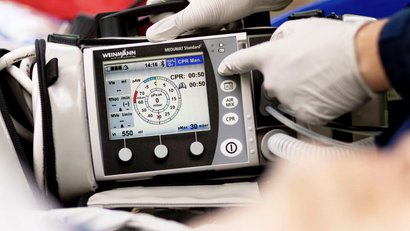
MEDUMAT Standard² is a versatile ventilator designed for all emergency situations in emergency medical services. It offers all clinically relevant ventilation modes – CPAP, CPAP + ASB, BiLevel + ASB/BIPAP, PCV, and aPCV – and supports both invasive and non-invasive ventilation.
Weighing 2.5 kg and with a battery runtime of up to 10 hours, MEDUMAT Standard² is ideal suited to emergency situations. The device can be used on patients weighing 3 kg or more and is suitable for a wide range of applications – from infants to adults.
The CCSV mode is particularly worth highlighting: this device synchronizes mechanical breaths with chest compressions during CPR without interrupting the chest compressions. The combination of effective oxygenation and improved perfusion makes CCSV a clinically significant advance in resuscitation care.
Bluetooth® transmission of vital ventilation parameters supports digital incident documentation and enables seamless data transfer to the receiving hospital. MEDUMAT Standard² integrates seamlessly with WEINMANN’s LIFE-BASE portable units.
MEDUVENT Standard – turbine-driven and independent of compressed gas

MEDUVENT Standard is one of the world’s smallest and lightest turbine-driven emergency and transport ventilators. Weighing just 2.1 kg and with a volume of 3.5 liters, it is ideally suited for missions where every gram counts – whether in air rescue, disaster response, or when treating injured patients in hard-to-reach locations.
As a turbine-driven system, it operates without an external compressed gas supply and can deliver inspiratory oxygen concentrations ranging from 21 % to 100 % without consuming oxygen itself. With a runtime of up to 7.5 hours at typical ventilation settings for an adult, it is also suitable for long-term use without an external power source. Non-invasive ventilation is also possible with MEDUVENT Standard.
MEDUCORE Standard² – monitoring and defibrillation in one device
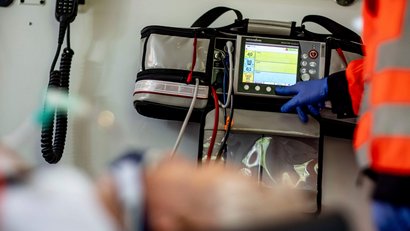
MEDUCORE Standard² combines patient monitoring and defibrillation in a single compact unit. All vital signs – ECG (6- and 12-lead), heart rate, SpO₂, and NIBP – can be quickly and intuitively monitored at any time thanks to color coding and night view.
The 12-lead ECG can be e-mailed to the admitting hospital even before the patient arrives – ensuring a structured pre-registration process and a smooth patient handoff. When used in combination with MEDUMAT Standard² or MEDUVENT Standard, emergency responders can view all relevant vital signs and ventilation data at a glance.

FAQ
The main difference lies in access to the airways: in invasive ventilation, this is achieved using a tracheal tube or a tracheal cannula; in non-invasive ventilation (NIV), ventilation is provided via a mask – without any intervention in the airways.
In emergency medical services, NIV is preferred as the primary intervention whenever possible. However, if there is no clinical improvement or if there are contraindications, intubation must be performed immediately.
The basic parameters include oxygen saturation (SpO₂), heart rate, respiratory rate, non-invasive blood pressure (NIBP), and a 6-lead ECG. In addition, end-tidal CO₂ (etCO₂) is measured via capnography, depending on the clinical situation. The etCO₂ provides immediate information about the effectiveness of ventilation and the quality of ongoing cardiopulmonary resuscitation.
A 12-lead ECG is essential for advanced emergency diagnostics, such as when acute coronary syndrome is suspected. Continuous monitoring of these parameters forms the basis for every therapeutic decision made in clinical practice.
Key features include intuitive operation even under stressful conditions, a wide range of ventilation modes, including NIV capability, and a robust, compact design for mobile use. In addition, devices should have sufficient battery life or operating time without an external power source and be equipped with a reliable alarm system that clearly prioritizes warning messages.
A wide range of patients – from children to adults – as well as easy integration into existing portable units are other important factors. Last but not least, service plays a key role: Regular servicing and device-specific training are essential to ensure that emergency responders can operate the equipment safely in an emergency.