


Resuscitation Following Drowning for Emergency Medical and Water Rescue Services

In drowning, cardiac arrest is generally hypoxic, meaning that ventilation and oxygenation take precedence over the classic “compression first” principle of CPR.1
The success of treatment following a drowning accident depends on two points in time: on the water, where first aiders frequently undertake the first ventilation steps and then at the interface with the emergency medical services who take care of airways, ventilation, and handover to hospital. The decision on mode of transport if there is concomitant hypothermia is another factor.2
Resuscitation following drowning: the key facts in brief
- First, ventilation: cardiac arrest following drowning is a consequence of lack of oxygen. Oxygenation therefore takes precedence over the conventional “compression first” principle of CPR.
- 5 ventilations, then 30:2. Following an initial 5 ventilations, CPR is performed in a ratio of 30:2, with and AED deployed early. Chest compressions only work on a firm surface, not in the water.
- Don’t waste any time: forcing water out of the lungs achieves nothing and delays ventilation. Nor should bracing of the spinal column be allowed to delay the start of resuscitation.
- Warmth protects: wet clothing must be removed and the affected person insulated. Perform resuscitation until the drowning victim’s body temperature is back to normal, applying the maxim: “Nobody is dead until they are warm and dead.”
- If in doubt, always send to hospital - even after a brief improvement - there is the potential for both aspiration and delayed respiratory deterioration.
Why resuscitation following drowning is different to classic CPR
With resuscitation following drowning, ventilation takes priority because the cardiac arrest is down to hypoxia. This means that accidental drowning is one of the few exceptions when you do not start with chest compressions as you would otherwise do in CPR.1
The trigger for cardiac arrest is lack of oxygen, not primarily heart function..2 The core consequence of this is that we need to get oxygen into the lungs as early as possible. 1,2
The European Resuscitation Council (ERC) guidelines specifically modify the classic approach. If the patient is not breathing normally, start resuscitation following drowning with 5 initial ventilations before transitioning to standard CPR in a ratio of 30:2.3
The same modification applies to children. Here too, 5 initial ventilations should be administered before the first chest compressions, as the hypoxic mechanism is not age-dependent.1 However, note the compression ratio: professional resuscitation of children is performed in a ratio of 15:2.
Furthermore, resuscitation following drowning should not involve removing water from the lungs. Attempts to force out water assumed to have been taken in achieves nothing and only delays ventilation and increases the risk of vomiting and aspiration. Immediate ventilation therefore always takes priority.2
Nor should bracing of the spinal column be allowed to delay resuscitation. If trauma is suspected, perhaps following a jump into shallow water, the cervical spine should be treated gently, but the start of resuscitation should not be delayed. The airway is then carefully cleared, using the jaw thrust maneuver, for example.4
Mnemonic: for drowning, resuscitate the lungs first!
Basic approach: five-step first aid for drowning
First aid for drowning follows five sequential steps, each of which builds on the previous one - from getting the patient to safety, to early ventilation, and on to CPR and AED. The entire process is accompanied by keeping the patient warm and preparing him/her for handover to hospital.
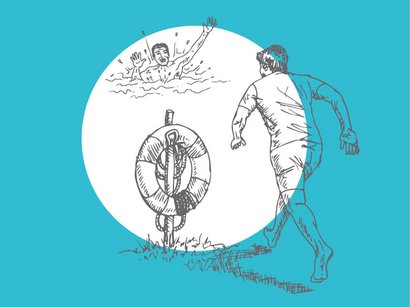
Step 1: Protect yourself, rescue, call the emergency services
Your own safety comes ahead of a rescue. Never swim to a drowning individual unsecured, otherwise two people will be in danger. Only help if you can do so safely. If possible, use a flotation aid such as a life-belt, float or pole.5
In parallel, get a call in to your emergency services number (for example 911, 999, 112), giving precise details of location, number of people involved, and their state of consciousness/breathing. If there are plenty of helpers on the spot, assign roles at an early stage: rescue, resuscitation, defibrillator, and keeping warm.5
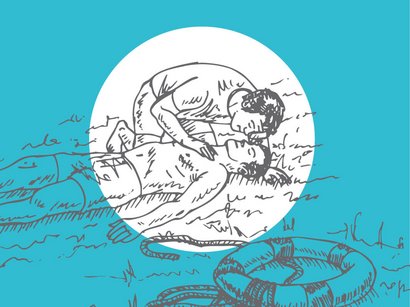
Step 2: Check consciousness & breathing (≤10 s)
After the rescue, check responsiveness and breathing. The breathing check should not last more than 10 seconds.1 Abnormal breathing - and this includes gasping for air – is a symptom of cardiac arrest and triggers resuscitation.2
If the person is conscious and breathing normally, make sure they are kept warm and monitored closely until the emergency medical services arrive. Move the person as little as possible and keep them as horizontal as possible in order to avoid fatal afterdrop as a consequence of circulatory collapse.2
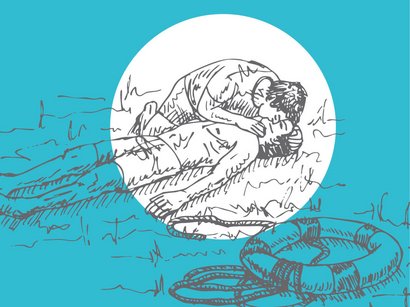
Step 3: 5 initial ventilations
If the airways are free, administer 5 initial ventilations of approximately 1 second each until you see the thorax lift. If oxygen is available, ventilate with 100% O₂. Avoid ventilations which are excessively powerful or quick, as these lead to gastric insufflation and vomiting. Leave ventilation to trained EMS field providers as soon as you are in shallow water.5
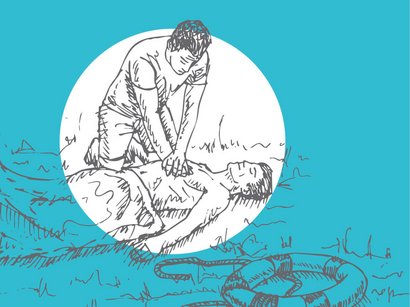
Step 4: CPR 30:2 + AED
After the 5 initial ventilations, switch to standard CPR using a ratio of 30 chest compressions to 2 ventilations. For adults, 100–120 compressions per minute apply with a pressure depth of 5–6 cm; stop applying any force at all after each compression.1
The defibrillator is deployed at an early stage. Dry the ribcage off first and position the electrodes correctly. If possible, continue chest compressions while the pads are being attached. Effective chest compressions are only successful on a firm surface, not in the water.1
Step 5: Keep warm and prepare for handover
Remove wet clothing, dry the person, and protect them from hypothermia using a blanket and a windbreak. Continue resuscitation until the emergency medical services take over or stable, normal breathing sets in.2
Clinical investigation is always indicated if there is any doubt, even if the patient has recovered briefly. Note the key data for the handover: approximate time under water, start of resuscitation, measures implemented, and observations.4
For the emergency medical services: airway, ROSC, and handover
Once the emergency medical services take over, the focus moves from initial ventilations to permanent airway management. Key factors now are controlled ventilation, suction on permanent standby, and structured handover to the hospital.1
Airway & ventilation
Ventilate with 100% oxygen. Airway management aims for early endotracheal intubation and subsequent PEEP ventilation, as high ventilation pressures are often required following drowning.6
These high ventilation pressures and pronounced risk of aspiration mean that supraglottic airway devices are suitable only to a limited extent. Keep suction on standby, but use it only for specific purposes: only use suction if ventilation is otherwise impossible - not prophylactically and not continuously.6
Expect frequent vomiting and aspiration from the outset. If hypothermia is also present, the following also applies: continue with resuscitation until a normal body temperature is achieved in hospital – apply the principle “Nobody is dead until they are warm and dead".7
„Nobody is dead until they are warm and dead"
In the event of severe hypothermia, the cold reduces the brain’s requirement for oxygen and can thus provide temporary protection from hypoxia damage. Signs of life are then often barely perceptible, even though death has not actually occurred. This is why resuscitation is continued and death only confirmed after the body has been warmed back up to a normal temperature and if measures continue to be unsuccessful.
Following ROSC (compact)
Following the return of spontaneous circulation (ROSC), oxygenation takes precedence. Take consistent action to prevent hypoxia recurring. Monitor the airways and SpO₂ closely, as respiratory insufficiency up to and including ARDS may develop following drowning.6
Handover checklist (6 items)
A structured handover accelerates further treatment. The following 6 items should be recorded and handed over:
- Duration of submersion (if known)
- Time BLS/ALS started
- ROSC yes/no, initial rhythm
- Measures: 5 ventilations, CPR cycles, defibrillator shocks
- Temperature/hypothermia
- Aspiration, vomiting, airway status
Resuscitation with hypothermia
Cold water often means concomitant hypothermia, which is why keeping the patient warm and handling them gently form part of resuscitation.
For all emergency responders
Remove wet clothing, dry the person, and insulate them using a blanket, ground insulation, and a windbreak. Continue resuscitation until the emergency medical services take over or stable, normal breathing sets in.
Additional information for the emergency medical services
In the case of severe hypothermia, the cardiac conduction system is unstable, so move the individual gently and transport them horizontally in order to prevent afterdrop. Extended resuscitation may be meaningful in accordance with your local SOP: do not stop prematurely - the maxim “Nobody is dead until they are warm and dead” is key here too.
In the case of severe hypothermia and extended resuscitation, consider transport to a specialized treatment center, perhaps using extracorporeal membrane oxygenation (ECMO) to bring the patient back to a normal temperature - depending on the healthcare trust’s protocol.6
Four common myths around resuscitation following drowning
The summary below compares the guideline-compliant procedure against widespread misconceptions.
| Myth/error | Correct |
|---|---|
| Force water out of the lungs | Ventilate immediately - every second counts |
| Suction indefinitely | Only if breathing is obstructed; otherwise ventilate |
| Ventilation too aggressive | Moderate volume, thorax rising visibly |
| Stop too early | Until emergency medical services take over/handover to hospital or normal breathing is stable |
Effective ventilation for resuscitation following drowning – with WEINMANN
With drowning, rapid, effective ventilation via oxygenation is key - at the waterside, where water rescue services frequently perform initial ventilations - and equally with the emergency medical services who provide airway management. WEINMANN bundles the right components for both spheres of operation in emergency ventilation and airway management.
Use ACCUVAC Pro to clear the airways
Regurgitation and secretions regularly prevent ventilation following drowning. In such cases, ACCUVAC Pro rapidly clears the airways and is used specifically to stop ventilation being interrupted for longer than necessary.
Rapid one-person ventilation using MEDUtrigger
For the 5 initial ventilations and the subsequent cycles in the ratio 30:2, MEDUtrigger (trigger for manually triggered ventilation) allows just one emergency responder to administer mask ventilation with 100% oxygen initiated directly at the mask, leaving his/her other hand free.
Reliable endotracheal intubation with MEDUVISION
The MEDUVISION video laryngoscope supports intubation even in cramped or unusual situations. A flexible display angle can be set to allow low-reflection intubation, whilst the transflective allBRIGHT display ensures high visibility, even in bright sunlight on the beach or at sea.
Optimal ventilation under resuscitation with CCSV
CCSV (Chest Compression Synchronized Ventilation, WEINMANN’s in-house ventilation mode) synchronizes ventilation with chest compressions. CCSV delivers significantly better oxygenation under resuscitation than other ventilation types and ventilates at high ventilation pressures and with PEEP, without impairing venous return flow. 8,9
FAQs
Five stages are classically described:
- Surprise on realizing the danger
- Deliberate holding of the breath (in some cases with reflexive laryngospasm)
- Unconsciousness due to lack of oxygen
- Hypoxic cramps
- Clinical death with respiratory and cardiac arrest
However, current guidelines consider drowning to be a continuum of respiratory impairment, not a series of strictly discrete stages.
There is no hard and fast duration. Resuscitation continues until spontaneous circulation returns, the emergency medical services take over or stable, normal breathing sets in. Extended resuscitation is particularly justified in the event of concomitant hypothermia.
“Dry drowning” is a popular but medically superseded term for suffocation due to laryngospasm, in which hardly any water enters the lungs. Specialists now uniformly define drowning as respiratory impairment as a result of submersion. Terms such as “dry” or “secondary” drowning are no longer recommended. What remains relevant for the field is that symptomatic individuals should be kept under medical supervision following a water-based emergency.
1 European Resuscitation Council (ERC), Leitlinien 2025, Kapitel „Ertrinken" (BLS/ALS); deutschsprachige Aufbereitung: FOAMio – ERC 2025. foamio.org/erc-2025/
2 MSD Manual, Profi-Ausgabe: „Ertrinken". https://www.msdmanuals.com/de/profi/verletzungen-vergiftungen/ertrinken/ertrinken
3 Notfall + Rettungsmedizin (Springer): Modifikation des Reanimationsablaufs bei Ertrinken – 5 Beatmungen vor Thoraxkompressionen. https://link.springer.com/article/10.1007/s10049-015-0097-6
4 AMBOSS SOP: Ertrinkungsunfall. https://www.amboss.com/de/wissen/ertrinkungsunfall-amboss-sop
5 Malteser: Erste Hilfe bei Badeunfällen und Ertrinken. https://www.malteser.de/aware/hilfreich/die-nasse-gefahr-erste-hilfe-bei-badeunfaellen-und-ertrinken.html
6 Thieme (Notfallmedizin up2date), Abstract: Ertrinkungsunfälle. https://www.thieme-connect.com/products/ejournals/abstract/10.1055/a-2364-7666
7 RD-Factsheets: Ertrinkungsnotfälle. https://rd-factsheets.de/fs/ertrinkungsnotfaelle/
8 Kill C, Galbas M, Neuhaus C, et al. Chest Compression Synchronized Ventilation versus Intermitted Positive Pressure Ventilation during Cardiopulmonary Resuscitation in a Pig Model. PLoS One. 2015;10(5):e0127759. doi:10.1371/journal.pone.0127759