


Advanced Life Support Ambulance Equipment

In Germany, the correct equipment in ALS Ambulances (advanced life support ambulances) is subject to clear specifications and standards in order to guarantee uniform quality in emergency medical services. This ensures that patients across Germany receive state-of-the-art care.
In this article, you will find out which requirements currently apply to ALS Ambulance equipment and how you can optimally equip your vehicle with devices and accessories from WEINMANN.
ALS Ambulance equipment: the most important facts in brief
- An ALS Ambulance (type C) is a special vehicle for emergency care and patient transportation.
- The equipment is based on EU standard DIN EN 1789 vehicle type C as well as regional specifications and medical guidelines.
- Much of the equipment consists of medical devices, which are divided into classes (I to III) depending on risk.
- The standard equipment includes a stretcher, suction device, ventilator, ECG/defibrillator, syringe pump, medication, consumables and diagnostic accessories.
With WEINMANN, you can count on reliable, standard-compliant equipment for your ALS Ambulance.
EMS (emergency medical services) vehicle types
German EMS use various types of vehicle, each of which is equipped differently and can be clearly distinguished from one another:
- Advanced Life Support Ambulance (type C): An ALS Ambulance is a specially equipped EMS vehicle. It is used to treat and transport emergency patients, taking them to the nearest clinic or a specialized facility.
- Basic Emergency Ambulance (type B): A Basic Life Support Ambulance (BLS ambulance) is used for the initial treatment and transportation of emergency patients. The aim is to quickly restore or maintain the patient’s ability to be transported, but not to provide further treatment.
- Patient Transport Ambulance (type A): Patient Transport Ambulances are used to transport patients who are not in acute danger. They are generally smaller than ALS Ambulances and have less equipment. Type A1 Patient Transport Ambulances transport a single patient, type A2 ambulances can transport multiple patients.
- Emergency Physician Vehicle: The Emergency Physician Vehicle is used exclusively as a means of transport for the emergency physician and to carry extended medical equipment. It does not transport patients.
- Emergency Physician Ambulance: An Emergency Physician Ambulance is an ALS Ambulance with an emergency physician on board.
- Intensive Care Transport Vehicle: The Intensive Care Transport Vehicle is used for intensive care transfers. It also contains intensive care equipment.
In addition, there are other special vehicles in which the equipment has been adapted as required (e.g. infection ambulances, large-capacity ambulances, etc.). The most important key data on the various vehicles used in emergency medicine can be found in the table below.
- Patient Transport Ambulance
Transport of patients where there is no acute emergency indication
- BLS Ambulance
Transport and prehospital emergency care of emergency patients
- ALS Ambulance
Life-saving emergency care and emergency transportation
- Emergency Physician Vehicle
Transport of emergency physician but not patient transport
- Emergency Physician Ambulance
Ambulance with an emergency physician as part of the crew
- Intensive care transport vehicle
Intensive care transfer
What tasks does an ALS Ambulance perform?
An ALS Ambulance is used for the prehospital care of emergency patients and the qualified transportation of people requiring medical monitoring. The primary tasks include emergency medical care and transportation as part of EMS responses (primary deployment) as well as transfers between medical facilities (secondary transportation) if continuous medical care is required.
The ALS Ambulance provides the necessary infrastructure for prehospital emergency care at the scene in accordance with the guidelines. This includes both the medical-technical equipment – including for airway management, circulatory stabilization and monitoring – as well as the specialist emergency medical service personnel who have the appropriate qualifications.
The aim of prehospital measures is to maintain or restore vital functions. An essential component is also the structured transfer to an appropriate target hospital, based on the respective care capacities (e.g. cardiac catheter standby, stroke unit, level 1 trauma center).
What are the requirements for road ambulances according to DIN?
The equipment has to comply with DIN EN 1789. The EU standard for road ambulances defines minimum medical technology requirements and guarantees a uniform standard throughout Europe. It ensures that both the vehicle and the equipment correspond to the current standards of research and technology.
The EU standard for road ambulances defines 3 vehicle types, with type C describing the ALS Ambulance in Germany.
- Type A1 and A2: Patient Transport Ambulance
- Type B: BLS Ambulance
- Type C: ALS Ambulance
Only type C is suitable for EMS responses with and without an emergency physician. It offers advanced possibilities for monitoring and treating patients. A type B vehicle may only be used for emergency response if it exceeds the minimum medical technology requirements of DIN EN 1789.
The S1 to S3 guidelines should also be incorporated to ensure that the equipment in the road ambulance remains “state of the art”. Depending on the clinical picture and recommended action, they formulate specific requirements for the necessary devices and medication.
The equipment of a road ambulance is also influenced by regional specifications: staffing regulations vary from state to state and the Medical Directorate for Emergency Medical Services (ÄLRD) also makes independent decisions – for example with regard to medical equipment, for which there is no standardized nationwide regulation.[1]
ALS Ambulance (type C) equipment
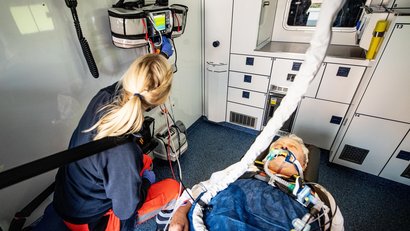
Medication, devices and transportable equipment must be available in the ALS ambulance in order to maintain vital functions and prevent serious harm to health. A large proportion of the equipment in the ALS Ambulance is medical devices.
Medical devices are instruments, apparatus, devices, software, implants, reagents or other objects intended for medical use on humans. They are used, for example, to diagnose, monitor, predict, treat or alleviate diseases or injuries – or support physical functions or processes without having a primarily pharmacological, immunological or metabolic effect.
Medical devices can pose a hazard if they are not used properly. For this reason, they are divided into four risk classes I, IIa, IIb and III according to the EU Medical Device Regulation (MDR), with class III representing the highest risk:
- Class I: Low-risk products, e.g. non-invasive products or accessories for class IIa devices.
- Class IIa: Medium-risk products, e.g. non-invasive products for changing the composition of blood or body fluids (e.g. dialysis filters) and certain surgically invasive devices and products for short-term use.
- Class IIb: Products with increased risk, e.g. invasive products for long-term use and complex active products for wound treatment.
- Class III: Products with the highest risk, e. g. products for monitoring, diagnosis, control or correction, control of central cardiovascular functions or implantable products.
The materials required for comprehensive medical care in the ALS Ambulance – divided into classes – are:
- Class 1
Stretcher and carrying accessories
Enables safe patient transport and initial medical measures during the journeyVacuum mattress
Used to immobilize trauma patients for safe positioning and stabilization- Class 2
Ventilator
Supports or completely takes over the work of breathing if spontaneous breathing is absent or insufficientPressure reducer
Regulates the pressure of oxygen cylinders for use with medical devices and enables a controlled oxygen supply- Class 2a
Suction device
Creates a vacuum to remove secretions and foreign bodies from airways – to keep airways clear- Klasse 3
ECG and defibrillator
Record the ECG and initiate defibrillation in the event of a shockable rhythm (e.g. ventricular fibrillation)
As each medical device is classified individually, there are groups of ambulance devices that cannot be assigned to a general class.
- Consumables such as bandages typically fall into Class I.
- Diagnostic accessories such as a stethoscope or a sphygmomanometer must also be available in the ambulance. They largely belong to Class I.
Medication does not count as a medical device but is an essential part of any comprehensively equipped ALS ambulance.
The ALS ambulance must be staffed by qualified personnel in accordance with the respective state laws, in any case by at least one paramedic. They are qualified and trained to use this equipment correctly.
WEINMANN ambulance equipment
WEINMANN ambulance equipment
WEINMANN products fulfill all legal requirements and conformities. With our devices for ambulances, you can treat patients reliably and in accordance with guidelines: for safe care during an emergency response. Get to know our products now.
MEDUMAT Standard²
MEDUMAT Standard² is a mobile ventilator that enables both invasive and non-invasive ventilation. Weighing just 2.5 kg, it is extremely compact. The battery runtime of up to 10 hours also allows longer assignments in the ambulance or in remote areas.
CCSV (Chest Compression Synchronized Ventilation) makes the device the ideal choice for resuscitation: ventilation is synchronized with chest compression and thus supports effective CPR. In addition, the integrated CPR mode offers safe and controlled care during resuscitation measures.
Anesthesia induction as part of an RSI is also specifically supported. Safe ventilation of infants, children and adults is possible from a body weight of just 3 kg.
The optional integrated flow and CO₂ measurement enables extended, precise monitoring of ventilation and thus increases patient safety during the entire operation.

MEDUVENT Standard
MEDUVENT Standard is one of the smallest turbine-powered emergency ventilators in the world – and yet it is highly efficient. The device enables both invasive and non-invasive ventilation – independent of an external compressed gas supply and with an operating time of up to 7.5 hours. Oxygen concentrations between 21% and 100% can be flexibly adjusted.
Comprehensive monitoring of patient parameters – including pressure and flow curves – ensures maximum control throughout ventilation. And with a weight of just 2.1 kg, MEDUVENT Standard is particularly handy and takes the physical strain off paramedics during their assignments.

ACCUVAC
ACCUVAC Pro is a portable suction device used to clear airways. This step is particularly important as effective ventilation may only be possible after suctioning.
Thanks to its handy design, it can also be used flexibly outside the ambulance. It offers powerful suction, is easy to clean and has 4 predefined suction levels. The powerful rechargeable battery ensures high operational readiness. ACCUVAC Pro is also suitable for evacuating vacuum rails and mattresses, making it multifunctional.
ACCUVAC Lite can also be used as ambulance equipment. In contrast to the ACCUVAC Pro, ACCUVAC Lite is operated via a continuously variable controller.


OXYWAY
OXYWAY is a pressure reducer for oxygen therapy and for supplying ventilators and vehicle systems (medical gas supply system). Thanks to the modular system, OXYWAY can be individually configured. The pressure reducers are compact, rugged and durable, making them particularly suitable for emergency medical service assignments.

RESCUE-PACK Plus
The RESCUE-PACK Plus emergency backpack not only brings consumables safely to the scene, but is also designed to transport our medical devices, such as ventilators. This means that the ambulance crew have everything they need to hand as well as both hands free.
Thanks to the viewing window and integrated charging interfaces, RESCUE-PACK Plus is optimally designed for transporting our ventilators. The backpack is lightweight, has a high-quality finish, is rugged and ideally equipped for demanding emergency medical service use.

Are you looking to buy equipment for your ambulance?

[1] https://link.springer.com/article/10.1007/s10049-022-01036-6